
There is no shortage of brain health advice. There is a considerable shortage of brain health advice ranked by how much difference it actually makes. Here are nine habits in rough order of impact, with an honest note on how strong the evidence is for each.
1. Protect your sleep
This is first because nothing else comes close. Memory consolidation — converting fragile new information into durable storage — happens substantially during sleep, with deep slow-wave sleep in the early night appearing especially important for factual memory.
Sleep also drives the glymphatic system, which clears metabolic waste from brain tissue and is markedly more active during sleep than waking. Seven to nine hours on a consistent schedule is the target. Consistency matters nearly as much as duration: going to bed and getting up at roughly the same time, including weekends, is worth more than a heroic Sunday lie-in.
2. Move, aerobically, most days
The evidence linking cardiovascular exercise to cognitive function is among the strongest in this field. Aerobic activity increases cerebral blood flow, raises BDNF levels, improves vascular health, improves sleep and improves mood — several plausible routes to the same destination.
The commonly cited target is about 150 minutes of moderate activity a week. A 25-minute brisk walk most days clears it. Consistency beats intensity for this purpose.
3. Get your blood pressure treated
Unglamorous and important. Midlife hypertension is one of the more consistently identified modifiable risk factors for later cognitive decline. The small vessels supplying the brain are particularly vulnerable to sustained high pressure.
This one is largely out of the lifestyle domain and into the medical one, which is precisely why it gets skipped in wellness articles. Know your numbers, and if they are high, treat them.
4. Fix your hearing
The habit most people have never heard framed as brain health. Untreated hearing loss shows a consistent association with cognitive decline in observational research. The proposed explanations include the cognitive load of constantly straining to follow conversation, reduced auditory input to the brain, and the social withdrawal that hearing difficulty tends to produce.
What makes this one notable is that it is straightforwardly fixable. If you are turning the television up or asking people to repeat themselves, get a hearing test.
5. Stay socially connected
Conversation is cognitively demanding in a way that is easy to underestimate: tracking what someone knows, following a thread, reading tone, retrieving the right word at speed. Social isolation is associated with faster cognitive decline, and loneliness carries measurable health effects across several systems.
This is harder to act on than a walking target, and worth the effort anyway. A standing weekly arrangement with a friend does more than an app.
6. Keep learning things that are genuinely hard
Brain training games reliably make you better at brain training games. Transfer to everyday cognition is weak, and the industry has been fined over how it marketed those claims.
What appears more promising is learning something substantively new and effortful — a language, an instrument, a craft with real technique. The difficulty is the point. Something that feels awkward for weeks is doing more than something you are already good at.
7. Eat a broadly Mediterranean pattern
No single food protects your brain. What has reasonable support is a pattern: vegetables and leafy greens, oily fish, berries, nuts, olive oil, whole grains, with limited ultra-processed food and added sugar. The MIND diet is a variation designed with cognitive outcomes in mind and is a sensible template.
Two practical notes. Hydration has an immediate and underrated effect — mild dehydration measurably impairs concentration. And a large blood-sugar swing after a heavy refined-carbohydrate lunch is a common and entirely avoidable cause of afternoon fog.
8. Manage stress deliberately
Chronic stress means chronically elevated cortisol, and the hippocampus — central to memory formation — is densely populated with cortisol receptors and appears particularly sensitive to prolonged exposure.
The method matters less than the regularity. Breathing practice, meditation, time outdoors, a hobby that occupies your attention completely — all reasonable. The one thing that does not work is intending to deal with it later.
9. Consider targeted supplementation, last
Deliberately last, and deliberately qualified. A supplement cannot compensate for poor sleep, inactivity or untreated hypertension, and any brand implying otherwise is misleading you.
Where supplementation makes most sense is a documented deficiency — B12 and vitamin D are the common ones, and both are worth testing rather than guessing. Beyond that, a well-formulated daily supplement can offer nutritional support for normal function alongside the eight habits above. It is a supporting act. Treat any product marketed as the lead as a warning sign.
Where to start
Do not attempt all nine. Pick the one where your gap is largest — for most people that is sleep or movement — and hold it for a month until it stops requiring effort. Then add the next.
None of this is exciting, and the unexciting interventions are the ones with the evidence behind them.
Frequently asked questions
Around 150 minutes of moderate aerobic activity a week is the figure that appears in most public health guidance. A brisk 25-minute walk most days meets it. Consistency matters more than intensity for cognitive benefit.
They improve your performance at the trained tasks. Evidence for transfer to everyday cognition is weak. Learning a genuinely new and difficult skill is a better use of the same hours.
Observational research shows a consistent association, with proposed explanations including cognitive load, reduced auditory input and social withdrawal. Association is not proof of cause, but hearing loss is easily treatable, which makes it an unusually good bet.
Related articles
MemoHoney Review 2026: An Honest Look at the Formula
What the label contains, what the ingredients do, and who this daily capsule is not for.
Read article →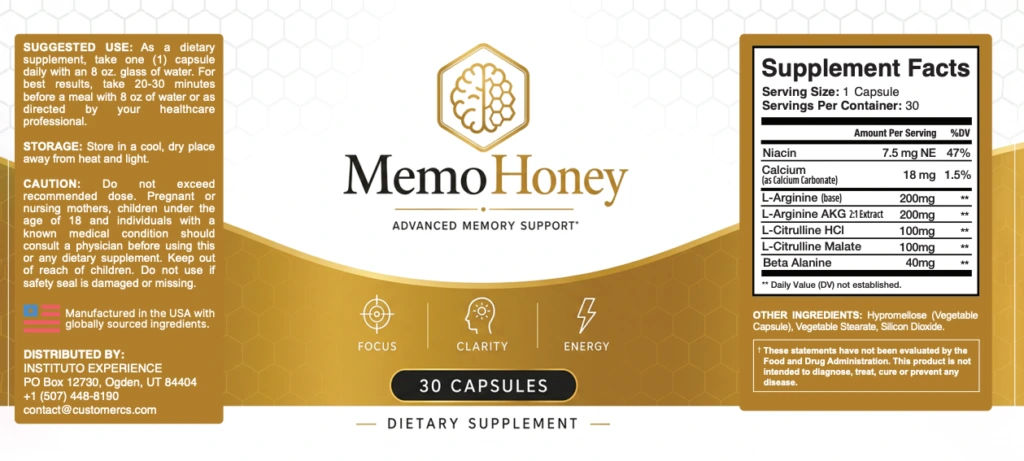
MemoHoney Ingredients Explained, One Line at a Time
A plain-English walk through all seven ingredients and the role each one plays.
Read article →
The Daily Memory Support Guide for Adults Over 40
Building a memory routine that survives a normal week.
Read article →