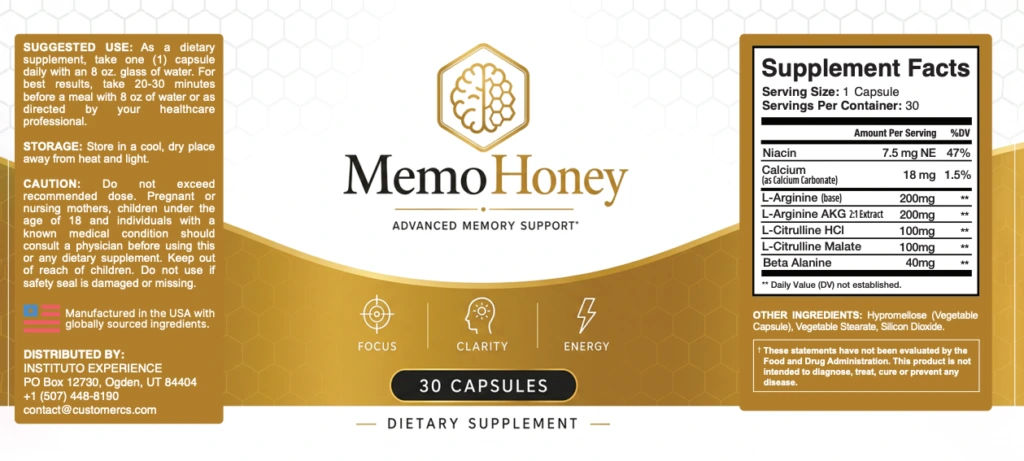
Supplement labels are written to satisfy regulators, not to be understood. This is the MemoHoney panel translated into ordinary language, ingredient by ingredient, including the two that are doing less work than the others.
Niacin (Vitamin B3) — 7.5 mg NE
Niacin is an essential B vitamin, meaning your body cannot make enough of it and you have to eat it. Its main job is as raw material for two coenzymes, NAD and NADP, which participate in hundreds of metabolic reactions — most importantly the ones that convert food into usable cellular energy.
Neurons are among the most energy-hungry cells in the body, so this is a sensible inclusion. Niacin also contributes to normal nervous system function and normal psychological function.
The 7.5 mg NE dose is about half a typical adult daily value, positioning it as topping up a normal diet rather than replacing dietary intake. Worth knowing: the very high doses of niacin sometimes used for other purposes can cause a flushing reaction. At this amount, that is not a realistic concern.
Calcium (as Calcium Carbonate) — 18 mg
Everyone knows calcium as the bone mineral. Its less-advertised role is in nerve signalling: when an electrical impulse reaches the end of a neuron, calcium ions flow in, and that influx is the trigger that releases neurotransmitters into the synapse. Without calcium, neurons cannot talk to each other.
Being straight about the dose: 18 mg is small, roughly one to two percent of a typical daily requirement. This is a supporting player, not a calcium supplement. If you are concerned about calcium intake, that is a diet and medical conversation, not something a memory capsule addresses.
L-Arginine (base) — 200 mg
Here the formula gets to its actual point. L-arginine is a semi-essential amino acid and the direct substrate for nitric oxide synthase, the enzyme that produces nitric oxide.
Nitric oxide is worth understanding because it is genuinely important. It is a gas, produced in the endothelium lining every blood vessel, and it diffuses into the surrounding smooth muscle and signals it to relax. Relaxed smooth muscle means a wider vessel, which supports healthy blood flow. The discovery of this mechanism won a Nobel Prize in 1998.
Arginine taken by mouth has one weakness: an enzyme called arginase, present in the gut wall and liver, breaks down a significant portion before it reaches circulation. Which brings us to the next ingredient.
L-Arginine AKG 2:1 — 200 mg
This is arginine bound to alpha-ketoglutarate in a two-to-one ratio. AKG is not filler — it is an intermediate in the Krebs cycle, the central process your cells use to generate energy.
So this ingredient delivers arginine for the nitric oxide pathway while contributing a metabolic cofactor alongside it. Whether the AKG form is absorbed better than plain arginine is genuinely debated, and you should treat confident claims in either direction with suspicion.
L-Citrulline HCl — 100 mg
Citrulline is the elegant solution to the arginase problem. Because it is structurally different from arginine, it passes through the digestive tract largely untouched, then gets converted to arginine in the kidneys.
The practical consequence is timing. Arginine arrives quickly but is partly lost on the way. Citrulline arrives later, more of it survives the journey, and it sustains arginine availability over a longer window. Including both is a considered choice rather than duplication.
There is a second reason the pairing makes sense. When nitric oxide synthase converts arginine into nitric oxide, it produces citrulline as a by-product — and that citrulline can be recycled back into arginine. The two amino acids form a loop, not a straight line.
L-Citrulline Malate — 100 mg
Citrulline again, this time paired with malic acid. Malate is the other Krebs cycle intermediate in the formula, so the reasoning mirrors the arginine AKG entry: the same amino acid, delivered with a compound involved in energy metabolism.
Together the two citrulline forms supply 200 mg, matching the 400 mg from the two arginine forms for a combined 600 mg aimed at a single pathway.
Beta Alanine — 40 mg
Beta alanine is a non-essential amino acid and the rate-limiting precursor to carnosine, a dipeptide that acts as an intracellular buffer in muscle and nerve tissue.
The honest assessment: 40 mg is a token dose. Beta alanine is studied at doses in the range of several grams daily, and 40 mg is not in the same conversation. It is harmless, and it is not the reason to buy the product.
One practical upside of the small dose is that the tingling sensation beta alanine can cause at higher amounts will not happen here.
What the panel adds up to
Six hundred and forty milligrams of combined amino acids, five of the seven ingredients pointed at one mechanism, and every dose disclosed. It is a focused formula rather than a comprehensive one, and it is honest about being focused.
Two ingredients — the beta alanine and to a lesser extent the calcium — are present at amounts that do not justify much weight in your decision. Judge the product on the arginine and citrulline content and on whether the circulation rationale persuades you.
Frequently asked questions
No. Every ingredient is listed with its individual dose on the supplement facts panel. This is the exception rather than the rule in this category, and it lets you compare the product against alternatives line by line.
They reach the same destination by different routes. Arginine is absorbed directly but partly broken down by arginase in the gut and liver; citrulline passes through largely intact and converts to arginine in the kidneys. One arrives fast, the other sustains.
Very unlikely at 40 mg. The tingling sensation associated with beta alanine occurs at doses roughly a hundred times larger than the amount in this formula.
Related articles
MemoHoney Review 2026: An Honest Look at the Formula
What the label contains, what the ingredients do, and who this daily capsule is not for.
Read article →
The Daily Memory Support Guide for Adults Over 40
Building a memory routine that survives a normal week.
Read article →
Nine Brain Health Habits That Are Worth the Effort
The habits with the strongest evidence, ranked by real-world impact.
Read article →